Tokyo Metro Ginza Line
Asia's first subway, opened on 30 December 1927 between Asakusa and Ueno, now running 14.2 km across 19 stations from Asakusa to Shibuya. The Ginza Line retains its original engineering — third-rail power at 600 V DC and standard-gauge track — largely unchanged since opening.
Asia’s First Underground Railway, 1927
On 30 December 1927, an underground railway opened between Ueno and Asakusa — two stations, approximately 2.2 kilometres, operated by the Tokyo Underground Railway Company. It was the first subway in Asia. At the time the line was promoted as “the only underground railway in the Orient,” and the reality of electric trains running beneath the streets of Tokyo drew crowds encountering the experience for the first time.
The line expanded gradually over the following decade. On 16 September 1939, through service between Asakusa and Shibuya was established, completing what is now the Tokyo Metro Ginza Line. Today the route covers 14.2 kilometres across 19 stations, threading under some of the most central districts of the city — Ueno, Kanda, Ginza, Shimbashi, Omotesando — before reaching its two termini at Asakusa in the east and Shibuya in the west.
Third-Rail Power and Standard Gauge: Specifications Unchanged Since 1927
The Ginza Line differs from every other Tokyo Metro route in its fundamental engineering. It draws power from a third rail running alongside the track rather than from overhead wires, and operates at 600 volts DC — both specifications adopted at opening to match the practice of established metropolitan railways abroad. Of Tokyo Metro’s nine lines, only the Ginza Line and the Marunouchi Line run on standard-gauge track (1,435 mm); the remaining seven use narrower gauges.
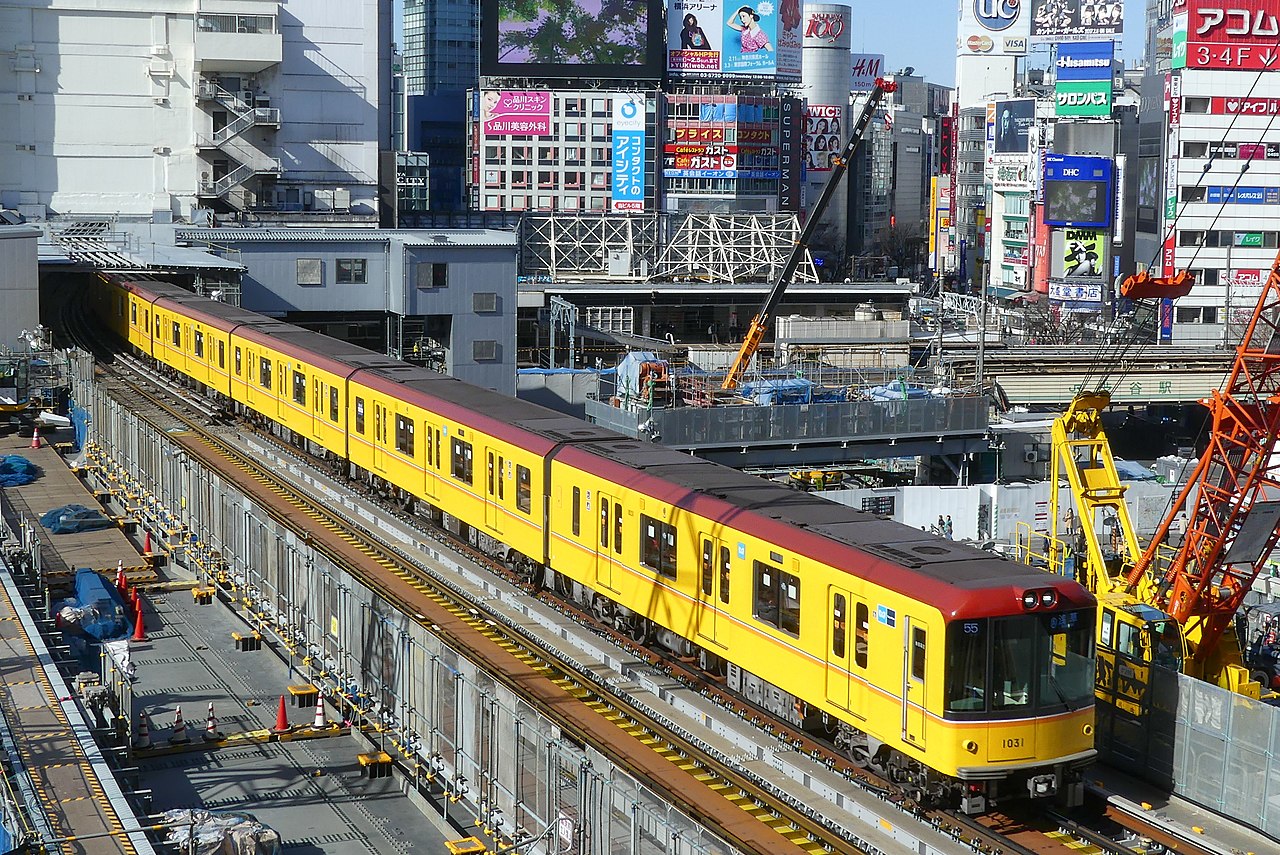
These specifications mean Ginza Line trains cannot run through to any other line, forming a self-contained network. Seen another way, the line has its own distinct world. In 2012, the 1000 series entered service with an exterior designed to echo the livery of the original 1000-type cars that ran in 1927, bringing a sense of the line’s early years back to the underground platforms. In 2009, the Ministry of Economy, Trade and Industry designated the Ginza Line as a Modern Industrial Heritage — one of the few operating railways in Japan to hold that recognition.
Summary
The Tokyo Metro Ginza Line opened in 1927 as Asia’s first subway and reached its full extent between Asakusa and Shibuya in 1939. Its 14.2-kilometre route across 19 stations remains technically distinctive: third-rail electrification at 600 V DC, standard gauge, no through-running with other lines. The line was designated a Modern Industrial Heritage in 2009. When visiting Asakusa, descend to the platform and watch the 1000 series train arrive — the curve of the tunnel, the glow of the third rail, and the retro-influenced livery carry close to a century of Tokyo underground history.
Related: Asakusa Culture Tourist Information Center / Kamiyacho Trust Tower (Tokyo World Gate)
Visiting Asakusa or Ginza? Rakuten Travel lists hotels throughout the Ginza Line corridor.
Related links
PR* The links below include advertising (affiliate links). We may earn a commission from purchases or bookings made through them.
References
- 東京メトロ 銀座線路線情報 https://www.tokyometro.jp/station/line_ginza/index.html
- メトロアーカイブアルバム 銀座線 https://metroarchive.jp/content/ginza.html/