Tokyo Skytree
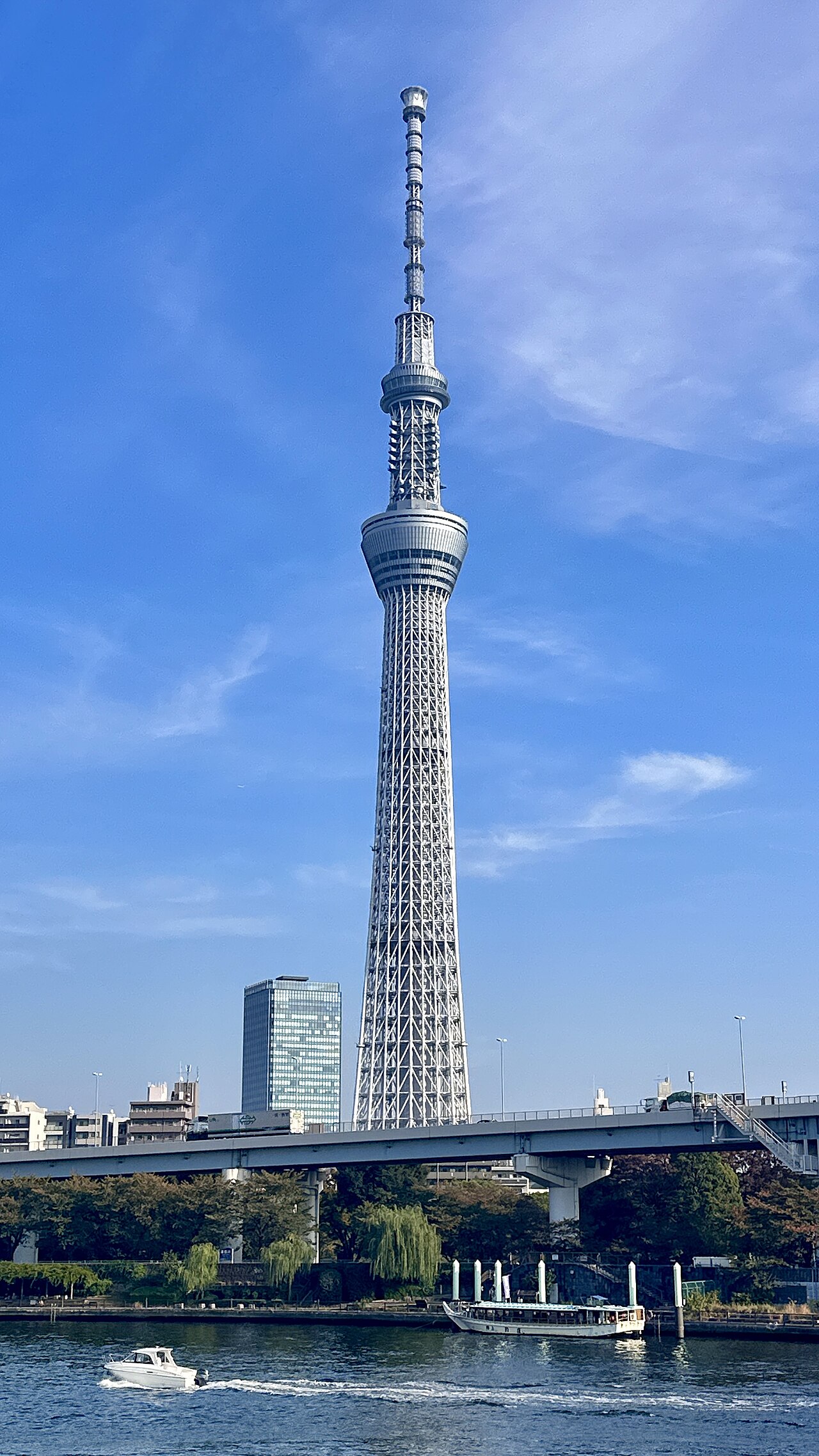
Completed in 2012 at 634 m, Tokyo Skytree is the world's tallest self-supporting broadcasting tower and transformed the old shitamachi neighbourhood of Oshiage into a global landmark.
- Use
- Office tower
- Area
- Sumida City
- Completed
- 2012
- Floors
- 29 above ground, 1 below
- Height
- 634 m
- Developer
- Tobu Railway / Tobu Tower Skytree Co., Ltd.
- Architect
- Nikken Sekkei (Design supervision: Kiichi Sumikawa)
The Answer Is Six Hundred Thirty-Four
Tokyo Skytree stands in Oshiage, Sumida City, completing on 29 February 2012 and opening to the public on 22 May of the same year. At 634 metres, with 29 floors above ground and one below, it is the world’s tallest self-supporting broadcasting tower. The design was handled by Nikken Sekkei, with sculptor Kiichi Sumikawa serving as design supervisor; Obayashi Corporation built the structure, and the development was led by Tobu Railway and Tobu Tower Skytree Co., Ltd.
The number 634 can be read as “Musashi” — the old province that covered much of the Tokyo area in the Edo period. The decision to build to exactly that height is said to reflect a deliberate effort to root this enormous new structure in the memory of the land beneath it.
A New Reference Point above the Old City
The practical reason for Tokyo Skytree was a nationwide transition to digital television broadcasting. As Tokyo’s skyline densified, the analogue signal from Tokyo Tower (333 m) became increasingly obstructed by the growing stock of high-rise buildings; a taller transmission point was needed. Tobu Railway held land in Oshiage, and the project of building a 634-metre tower above a traditionally low-rise neighbourhood set in motion a transformation of the entire district.
Inside, the tower holds two observation levels: the Tembo Deck at 350 m and the Tembo Galleria — a tube-shaped glass walkway — at 445–450 m. The commercial facility Tokyo Solamachi opened simultaneously with the tower, and Oshiage, once known for its quiet shitamachi atmosphere, remade itself almost overnight into a destination attracting visitors from across Japan and overseas.
The exterior is silver-grey, and the tower’s cross-section is a subtly tapered triangle that presents a slightly different silhouette from each direction. The form is said to draw on the traditional Japanese architectural curves known as sori and mukuri, giving a structure that is, at its core, a massive piece of industrial infrastructure a precision of outline that rewards sustained attention.
Summary
Completed in 2012 at 634 m, Tokyo Skytree was developed by Tobu Railway and Tobu Tower Skytree and designed by Nikken Sekkei. It serves as the primary digital broadcast transmitter for the Tokyo metropolitan area while standing as the defining landmark of eastern Tokyo.
For the best views of the tower, walk the riverside path along the Sumida or cross over from Asakusa. Pair it with the nearby Asakusa Culture Tourist Information Center — designed by Kengo Kuma — for a half-day that moves between the old city and its newest and tallest skyline marker.
Been here?
A self-reported stamp rally. Your record is stored only in this browser and never sent to a server.
Notes and photos stay on this device only — nothing is uploaded. Photos are resized to 1280px on the long edge before saving.
Related links
PR* The links below include advertising (affiliate links). We may earn a commission from purchases or bookings made through them.
References
- 東京スカイツリー公式サイト スペック・概要 https://www.tokyo-skytree.jp/about/spec/
- 東武タワースカイツリー株式会社 コーポレートサイト https://www.tokyo-skytree.jp/corporate/
- Wikidata Q57965(竣工2012年2月29日・開業2012年5月22日)
Map
Buildings near this one
Closest first, as the crow flies — walk straight on to the next tower.